

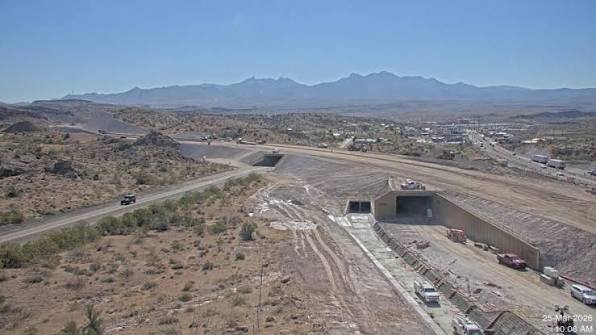
The Tippmann Group’s new cold storage warehouse in Kingman filled up within a couple of months of opening in 2024. The success was so immediate that the company began planning a second phase before the first year had even concluded.
Usually, standard supply chain rollouts provide companies with a few quarters to hire staff and refine delivery routes. But Kingman did not receive that grace period. The crunch hit so fast that by February 2025, the Tippmann Group had already greenlit a massive second phase for Interstate Warehousing.
They added 194,000 square feet and 24,000 pallet positions to a building that hadn’t even cleared its first full year of operation. By the end of that first year, the facility had processed nearly 100,000 orders, a volume that normally takes a regional hub years to establish.
The Rapid Rise of Cold Storage Demand
Due to its central location along the I-40 corridor, Kingman sits at the crossroads of Southwest freight routes. This makes it an obvious choice for companies looking to move goods quickly toward larger markets. Consequently, industrial demand in this part of Arizona is significantly high.
In June 2024, the Department of Transportation awarded RAISE Grant funding to the I-40 TradePort Corridor. This project connects Kingman to Winslow, Arizona, and reaches out toward Albuquerque.
It follows the heavy freight route moving east from the Port of Los Angeles, placing Kingman in a vital position for national trade. Through the creation of these alternative shipping lanes, federal planners are making Kingman a primary node in a network designed to keep the national supply chain moving efficiently. That also means planning for how the goods will move. The next generation of trucks on this corridor won’t all run on diesel.
Preparing for a Clean-Energy Transit Hub
Building an efficient modern transit network, however, requires more than just highway lanes; it demands green infrastructure. This is why Kingman is rapidly positioning itself as a premier hub for clean-energy transit along this 805-mile shipping corridor.
Backed by a $15 million federal RAISE grant, the city is preparing to host a massive Truck Mobility Complex. This complex is engineered specifically to service Class 8 electric and hydrogen-powered semi-trucks. Since these are heavy-duty alternative-fuel vehicles, they require dedicated charging and refueling stops before tackling the steep mountain grades up ahead.
Kingman’s geography makes it a non-negotiable staging ground. That kind of federal commitment doesn’t go unnoticed. It’s already changing how developers view the city.
Developers Are Moving Into Kingman
Kingman’s mayor reported a jump in developer inquiries within months of the TradePort’s federal designation. That response is consistent with how freight-dependent markets typically move when federal investment makes a location’s position on a trade corridor more certain.
Crews are already building a new interchange connecting I-40 and US-93. This will eventually become a part of the planned I-11 corridor linking Las Vegas to Phoenix, according to Kingman Economic Development’s 2025 report.
The project expands capacity at a junction where two major freight routes already converge. That’s a different proposition than building new access in an undeveloped area.
The Kingman Airport and Industrial Park already houses more than 75 companies and 2,300 employees, making it the largest industrial park, according to the City of Kingman. The infrastructure being added now is designed to support significantly more volume than the park currently handles.
Population Growth Is Outpacing Housing Supply
Warehouse expansion and federal infrastructure investment are adding jobs to Kingman at a pace the local housing market was not built to absorb. The city’s population grew from 32,693 at the 2020 census to an estimated 34,375 by 2024. That makes Kingman the 34th most populated city in the state of Arizona out of 441 cities, according to the U.S. Census Bureau American Community Survey data.
The Kingman population has grown 15.6% between 2019 and 2024. That’s an annual rate of 3.1%. With that pace, the population is projected to reach 36,525 by 2026. Search interest in Kingman AZ real estate has climbed alongside those numbers, a sign that the housing crunch is starting to draw outside attention.
Since much of that growth is tied to the city’s expanding logistics industry, it continues to attract new workers to the region. This is now pushing residential demand against a housing stock that has not expanded at the same rate as the job base.
The Critical Supply Bottleneck
Industrial investment is accelerating across Kingman, but residential construction has not expanded at the same pace. Listings on platforms like Houzeo and Zillow reflect that gap. Local MLS data from the Western Arizona Realtor Data Exchange put the city’s supply at 4.2 months in January 2026. While inventory increased from the previous month, it remained below the four-to-six-month threshold generally considered a balanced market.
A tight housing market would typically support rising prices, but Kingman is in a period of price correction instead. The median sale price fell to $274,250 in January 2026, down 6.4% year over year. Sales activity rose at the same time, with 75 homes closing that month, an 8.7% gain from a year earlier.
A quick look at listings on platforms like Houzeo and Zillow shows that homes priced near that median are moving fast, while pricier listings sit. Rather than signaling weak demand, the data suggests buyers are responding to competitively priced homes while overpriced listings remain on the market.
The Affordability Window Might Be Limited
Kingman still costs significantly less than Phoenix, Scottsdale, or Flagstaff. That gap is a big part of the appeal for people relocating there for work.
Inventory is already below what’s considered a balanced market, leaving little room to absorb the demand still coming. Prices aren’t likely to stay this low for long, since industrial investment is creating jobs faster than builders can put up new homes.