

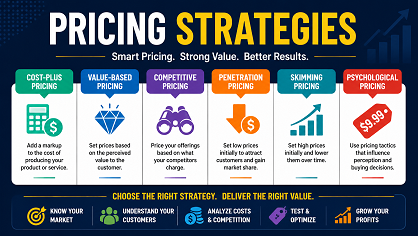
Pricing strategies play a crucial role in the overall success and profitability of any business. They not only define how a company positions its products and services in the market but also influence customer perception, market competitiveness, and ultimately, the bottom line. A well-thought-out pricing strategy can determine a company’s ability to attract and retain customers while ensuring optimal profit margins. The choice of pricing strategy can vary significantly based on factors such as industry standards, target demographics, and market conditions.
In essence, a pricing strategy encompasses the methodology and process of setting the prices for goods and services. This involves considering costs, competition, and market demand. While some companies may adopt a cost-plus pricing approach, others may leverage value-based pricing or competitive pricing tactics. Each of these strategies has its own merits and can yield varying results based on execution and context.
This blog post will focus on a specific pricing strategy that holds considerable potential for businesses aiming to double their profits. By strategically aligning pricing mechanisms with the value perceived by customers, organizations can enhance their profitability while simultaneously solidifying their market presence. Implementing the right pricing strategy not only impacts revenue but also fosters customer loyalty, making it an essential component for growth in an increasingly competitive landscape. As we delve deeper into this discussion, understanding the foundational concepts behind pricing strategies will equip companies with the insights necessary to refine their approach and capture greater market share.
Understanding the Psychological Impact of Pricing
The way consumers perceive pricing is deeply intertwined with their psychological response to value. This notion affects purchasing decisions, making it essential for businesses to strategically consider how prices are set. One of the pivotal concepts in this regard is price anchoring, which is the tendency of consumers to rely on the initial piece of information—often a higher price—when making subsequent evaluations about the value of a product. For example, if a product is initially presented at $200 and is later discounted to $150, the initial price serves as an anchor, making the discounted price appear much more attractive.
Another psychological factor influencing consumer behavior is the power of price thresholds. This refers to the specific price points that consumers perceive as significant demarcations. For instance, a product priced at $99 is typically seen as a better deal compared to $100, even though the difference is negligible. This phenomenon can heavily influence consumer choices, leading businesses to strategically employ pricing that falls below these thresholds to maximize engagement and sales.
The concept of perceived value versus actual value further complicates how pricing strategies can impact profit margins. Perceived value is subjective, based on personal experiences, brand reputation, and marketing messages, and can sometimes exceed the actual value. Therefore, companies often invest in branding and psychological marketing techniques to elevate the perceived value of their products, enabling them to charge higher prices. By understanding these psychological elements, businesses can craft pricing strategies that resonate with consumers’ expectations and enhance their revenue potential.
The Basics of Value-Based Pricing
Value-based pricing is a strategy where prices are set primarily based on the perceived or estimated value of a product or service to the customer rather than the cost of production or the prices set by competitors. This method contrasts with cost-plus pricing, which calculates the price by adding a fixed percentage to the cost of production, and competition-based pricing, which involves setting prices based on how competitors price their products or services. In value-based pricing, the focus lies on understanding the customer’s needs and how much they are willing to pay based on the benefits they derive from the product.
One notable advantage of value-based pricing is its ability to foster greater customer satisfaction and loyalty. By aligning the price with the perceived value of the product, businesses can create a more compelling proposition for customers. When customers feel that the price aligns with the benefits received, they are more likely to make a purchase and develop a loyalty to the brand. This alignment transforms the pricing strategy into a strategic tool that not only aims to drive sales but also builds long-term relationships with consumers.
Furthermore, employing a value-based pricing model can lead to increased profit margins, as businesses may find that customers are willing to pay more for products they perceive as high value. By properly communicating the unique advantages of the product and demonstrating its value, companies can differentiate themselves from competitors and justify higher pricing. Implementing this pricing methodology requires careful market research and an understanding of consumer behavior, but when executed effectively, it has the potential to significantly enhance profitability.
Identifying Your Value Proposition
Understanding your value proposition is critical for any business aiming to maximize profitability. A value proposition articulates why a consumer should choose your product over others, highlighting the unique benefits they will receive. To begin, assess the distinct features and advantages of your product that appeal to your target audience. Consider factors such as quality, innovation, customer service, and brand reputation. Evaluating these elements will help you differentiate your offerings in the marketplace.
Conducting market research is a valuable tool in identifying your value proposition. Gather insights through customer surveys, focus groups, or interviews to understand expectations and preferences. This feedback can help pinpoint what customers truly value and how they perceive your product relative to competitors. By aligning your product attributes with these insights, you can hone in on what makes your offering appealing.
Articulating your value proposition effectively is equally crucial. Use clear, concise language that resonates with your target audience. Ensure that the communication of your value proposition aligns with your brand’s overall messaging. Highlight the specific benefits that purchasers can expect from your product and consider using testimonials or case studies as evidence of your value. This helps build credibility and reinforces your commitment to delivering exceptional value.
Moreover, integrating your value proposition into your pricing strategy can further enhance your business success. Adjusting your pricing to reflect the benefits you deliver can attract customers willing to pay a premium for quality or unique features. By ensuring your pricing strategy communicates and reinforces your value proposition, you create a compelling reason for customers to choose your product, ultimately leading to increased sales and profitability.
Competitive Analysis: Pricing to Win
Conducting a thorough competitive analysis is a pivotal step in formulating an effective pricing strategy. Understanding your competitors’ pricing structures provides invaluable insights that can significantly influence your own pricing decisions. By analyzing competitors, businesses can identify key trends, price points, and services offered in the market, which helps in establishing a competitive advantage.
First and foremost, knowing your competitors’ pricing allows for benchmarking against industry standards. This practice helps businesses not only understand where they stand but also highlights areas for improvement. For instance, if competitors are charging more for similar products or services, there may be an opportunity to position your offerings as more cost-effective, thereby attracting price-sensitive customers. Conversely, if a competitor provides a lesser value at a similar price, it creates an opportunity to justify a higher price for your products by emphasizing exceptional quality, uniqueness, or additional features.
Moreover, competitive analysis aids in uncovering your unique selling points (USPs). By identifying how your products or services differ from those of competitors, you can craft a value proposition that resonates with customers while justifying your chosen pricing strategy. For example, if your product is of superior quality or offers added features unavailable elsewhere, this distinction can warrant a premium price. Additionally, by showcasing these USPs in your marketing, you can mitigate competition’s price-based advantages.
Furthermore, being aware of competitors’ promotional tactics can shape your pricing initiatives. Learning how other companies implement discounts, offers, or loyalty programs can guide you in developing strategies that uniquely respond to market demands while maintaining profitability. Harnessing the insights gained from competitive analysis enables businesses to set prices that not only attract customers but also communicate a clear value proposition that supports sustained growth.
Implementing the Pricing Strategy
To successfully implement a pricing strategy that can potentially double your profits, it’s essential to begin with clear pricing tiers. These tiers allow customers to select from different levels of service or products at varying price points. For instance, businesses can offer basic, standard, and premium packages, each tailored to meet the needs and budgets of different customer segments. This tiered approach not only maximizes revenue but provides customers with options that enhance their purchasing experience and satisfaction.
Furthermore, incorporating discount strategies can greatly influence consumer behavior. Offering seasonal discounts or limited-time offers can create a sense of urgency and encourage customers to make a purchase. Promotions such as “buy one, get one 50% off” or loyalty discounts for repeat customers can drive sales while fostering customer loyalty. However, these discounts should be well-planned to ensure they do not devalue the product or service.
Bundling offers is another effective tactic that can enhance your pricing strategy. By combining multiple products or services at a slightly reduced rate, businesses can increase their average transaction value. This not only encourages customers to opt for the bundle but also provides them with perceived savings. It’s important to communicate the value of the bundle clearly to maximize uptake.
Moreover, implementing time-sensitive promotions can create urgency and lead to quick decision-making. For example, providing a limited-time promotion that offers an exclusive discount can prompt hesitant buyers to make a purchase. To ensure effectiveness, it’s crucial to analyze market trends and customer responses to these offers.
Finally, regularly testing and adjusting prices based on market response is critical. Using analytical tools and customer feedback can help gauge the effectiveness of pricing strategies. This may involve A/B testing different price points or adjusting introductory offers based on sales performance. Regular monitoring enables businesses to stay agile and responsive to market demands, ultimately enhancing profitability.
Measuring Success: Key Metrics to Track
To effectively gauge the success of a pricing strategy, businesses should closely monitor several key performance indicators (KPIs). These metrics offer insights into various aspects of performance, allowing organizations to make informed decisions and adjustments as necessary. First and foremost, revenue growth is a critical indicator; it reflects the increase in sales over a specified period and is directly influenced by pricing adjustments. An analysis of revenue trends will help identify whether the pricing strategy is enhancing profitability or requiring modifications.
Another essential metric is the profit margin, which indicates the difference between revenue and the cost of goods sold. A comprehensive understanding of profit margins allows businesses to assess how pricing strategies have impacted overall profitability. Monitoring changes in profit margins can provide insights into the effectiveness of promotional offers or price increases. Customer acquisition cost (CAC) is also vital; this metric reveals the expenses associated with attracting new customers. A reduction in CAC, coupled with a successful pricing strategy, indicates that the business is effectively targeting and converting its audience while minimizing marketing expenditures.
Furthermore, customer lifetime value (CLV) should be tracked, as it measures the total revenue expected from a single customer throughout their engagement with the brand. An increase in CLV signals efficiency in customer retention and satisfaction stemming from effective pricing. By monitoring these metrics—revenue growth, profit margins, customer acquisition costs, and customer lifetime value—organizations can better understand the impacts of their pricing strategy, allowing for subsequent refinements and sustained profitability.
Case Studies: Successful Implementation
Numerous businesses have embraced the innovative pricing strategy discussed in this article, resulting in impressive outcomes. A notable example is Company A, a mid-sized software firm that faced stagnating revenue growth. By implementing tiered pricing, which allowed them to cater to different customer segments, they saw a 150% increase in subscription sales within the first six months. This approach not only enhanced their market reach but also improved customer satisfaction, as users felt they had access to plans tailored to their specific needs.
Another case is Company B, a retail clothing brand that struggled with inventory excess and decreasing profit margins. After conducting market research, the management introduced dynamic pricing, adjusting prices based on consumer demand, time of purchase, and stock levels. Within a year, the company reported a 75% reduction in excess inventory and a 30% increase in overall sales. However, they faced challenges in accurately predicting demand fluctuations and ensuring that their inventory systems were agile enough to support this strategy.
Company C, a local restaurant, adopted value-based pricing to better align its menu with customer perceptions of quality and value. After re-evaluating pricing on popular dishes based on customer feedback and competitor analyses, they managed to increase their average ticket size by 25%. The implementation was not without its challenges, including resistance from long-term customers who were accustomed to lower prices. Yet, after a series of promotional events and effective communication, customer transition was gradual, leading to overall enhanced profitability.
These case studies illustrate that successful implementation of the discussed pricing strategy can lead to substantial financial gains, but also highlight the various challenges that businesses may encounter. By adapting and overcoming these challenges, companies can optimize their pricing models, ultimately doubling profits and strengthening market position.
Conclusion and Next Steps
In reflecting on the pricing strategies discussed throughout this article, it is evident that numerous businesses can benefit from transitioning to a more value-based pricing model. By aligning prices with the perceived value delivered to customers, rather than solely relying on cost-plus pricing or arbitrary figures, companies can potentially unlock significant profit increases.
One of the main takeaways from this discussion is the importance of understanding the unique value propositions that your products or services offer. Engaging with customers to gather feedback can provide insights into what they value the most and how they perceive your offerings. This awareness enables businesses to tailor their pricing strategies effectively, placing emphasis on what consumers are willing to pay based on perceived benefits.
Another crucial aspect is the need for continuous assessment and adjustment of pricing strategies. The market landscape can change rapidly, influenced by consumer preferences, trends, and competition. Regularly revisiting your pricing model ensures that it remains aligned with market demands and customer expectations, paving the way for sustained profitability.
To embark on this transition, first, evaluate your current pricing strategy. Analyze customer feedback and market data to identify areas where value perception can be enhanced. Following this, consider revising your pricing structure to better reflect the value provided. Experiment with different pricing tiers or packages to cater to various consumer needs and enhance perceived value.
Ultimately, embracing a value-based pricing strategy could yield considerable dividends. By focusing on customer perceptions and value delivery, businesses are more likely to see profitability double, as consumers will be more inclined to pay for the distinct benefits they receive. Take these insights forward as actionable steps to revitalize your pricing strategies and promote sustainable growth in your organization.