

When a Texas landowner receives notice that a government agency, utility company, pipeline operator, municipality, or another authorized entity wants part of their property, hiring an attorney may seem like the obvious next step.
The more important question is what kind of attorney should handle the matter.
Eminent domain is not simply another real estate dispute. A condemnation case combines constitutional rights, Texas statutory procedures, litigation strategy, appraisal methodology, easement language, property valuation, and the future impact of a public project on the land that remains.
That combination makes experience particularly important.
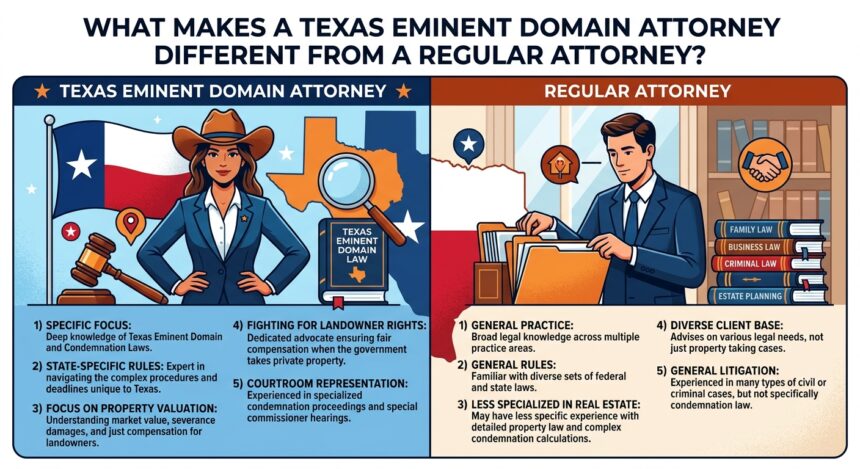
A Texas eminent domain attorney is generally distinguished from a general-practice attorney not by a separate license to practice condemnation law, but by concentrated experience handling the unusual legal, procedural, and valuation issues that arise when private property is being acquired through eminent domain.
For a Texas property owner, that difference can become significant long before a case ever reaches a courtroom.
Is a Texas Eminent Domain Attorney a Different Type of Licensed Lawyer?
Technically, every attorney practicing Texas law must satisfy the applicable licensing requirements to practice law in the state. Texas does not currently have a Texas Board of Legal Specialization certification specifically titled “Eminent Domain Law.” The state’s recognized real estate certifications instead include areas such as commercial, residential, farm and ranch, and property owners association law.
Therefore, the term “Texas eminent domain attorney” generally describes an attorney whose practice and experience are concentrated on condemnation and property-rights matters rather than a lawyer holding a separate eminent-domain license.
That distinction matters.
Legal specialization is often less about what appears on an attorney’s license and more about what the attorney regularly does. An attorney who repeatedly represents landowners in condemnation disputes is likely to encounter valuation disagreements, partial takings, easement negotiations, access issues, special commissioners proceedings, and challenges involving the remainder property far more frequently than an attorney whose practice covers many unrelated areas of law.
Eminent Domain Has Its Own Texas-Specific Legal Process
One of the largest differences between condemnation work and ordinary civil litigation is the procedure itself.
Under Chapter 21 of the Texas Property Code, an entity seeking to acquire property through eminent domain generally must first attempt to acquire the property voluntarily through a bona fide offer. Texas law establishes requirements for that process, including written offers and certain information that must be provided to property owners.
Texas landowners are also entitled to receive the state’s Landowner’s Bill of Rights. That document explains important protections, including a landowner’s rights concerning notice, negotiation, compensation, appraisal assistance, legal representation, the special commissioners process, and further court proceedings.
If negotiations do not resolve the acquisition, the condemning authority may initiate a formal condemnation proceeding.
Unlike most civil cases, Texas condemnation proceedings initially involve a three-member panel of court-appointed special commissioners tasked with hearing evidence and determining compensation. If a party objects to the commissioners’ findings within the statutory deadline, the dispute can proceed through the court system as a civil case.
An attorney unfamiliar with this process may understand civil litigation generally while still lacking substantial experience with the specific sequence of a Texas condemnation case.
A lawyer regularly handling eminent domain cases should already understand how each stage affects the landowner’s leverage at the next stage.
Property Valuation Is Often the Center of the Dispute
Another major difference involves valuation.
The central question in many eminent domain cases is not whether the condemning authority will acquire property. The dispute is often how much compensation is legally owed for what is being acquired and how the project affects the property that remains.
That requires more than reviewing an offer and comparing it to nearby real estate transactions.
A Texas eminent domain attorney may need to evaluate issues involving:
- fair market value;
- highest and best use;
- partial takings;
- remainder damages;
- changes to access;
- easement restrictions;
- development limitations;
- loss of visibility;
- changes in parcel configuration;
- utility or pipeline impacts; and
- the effect of the project on the property’s future marketability or use.
Texas’s Landowner’s Bill of Rights expressly recognizes that compensation can involve not only the market value of property being taken but, in appropriate circumstances, damages associated with a reduction in value to the owner’s remaining property.
This is where condemnation experience becomes highly relevant.
An experienced attorney should know that the government’s appraisal is evidence of value—not necessarily the final answer.
A General Attorney May Focus on the Acres Taken. An Eminent Domain Attorney Looks at the Entire Property.
Suppose a transportation project requires only a relatively narrow strip along the front of a commercial tract.
At first glance, the dispute may appear to concern the value of that strip.
But the real economic consequences could extend much further.
The acquisition could change driveway access. It could interfere with parking. It could move traffic closer to improvements. It could affect drainage. It could alter setbacks or development plans. It could make part of the remaining tract more difficult to use.
For agricultural property, a pipeline or transmission easement may divide fields, interfere with irrigation, restrict future improvements, create access rights for the easement holder, or complicate future development.
An attorney experienced in condemnation should therefore evaluate both the property being acquired and the effect of the acquisition on everything the landowner keeps.
That broader analysis can be one of the most important differences between general real estate representation and focused eminent domain representation.
Eminent Domain Attorneys Work Closely With Valuation Experts
Condemnation cases frequently require attorneys to work with professionals outside the legal field.
Depending on the property and the dispute, that may include:
- certified real estate appraisers;
- land planners;
- engineers;
- surveyors;
- brokers;
- agricultural experts;
- traffic specialists; or
- other valuation professionals.
The attorney’s job is not simply to hire an appraiser.
The attorney must understand enough about valuation to identify the correct issues, evaluate competing opinions, test assumptions, prepare expert witnesses, and explain the property owner’s damages in a persuasive and legally admissible manner.
That becomes particularly important if negotiations fail and the matter proceeds to a special commissioners hearing or trial.
Easement Language Can Matter Almost as Much as Compensation
Not every condemnation involves the government purchasing property outright.
Many cases involve easements.
Pipeline companies, electric transmission providers, utilities, drainage authorities, and other condemning entities may seek specific rights to use private property while the landowner continues to own the underlying land.
The compensation offered is therefore only part of the transaction.
The language defining the easement may determine what the condemning entity can do on the property for decades.
Texas law specifically addresses conveyance instruments in certain condemnation transactions and recognizes terms that may be negotiated in qualifying pipeline and electric transmission easements. The current Texas Landowner’s Bill of Rights includes information regarding those rights.
An attorney accustomed to condemnation work may pay close attention to issues such as access routes, width, location, temporary workspace, restoration obligations, vegetation, gates, future crossings, additional facilities, maintenance rights, and other restrictions.
A general attorney can read a contract.
An experienced condemnation attorney should understand how those provisions interact with the real-world future use of the property.
Condemnation Attorneys Understand the Special Commissioners Process
The special commissioners hearing is another feature that separates Texas condemnation practice from ordinary litigation.
The commissioners hear evidence concerning compensation and issue an award. Texas law then establishes a specific period for objecting to the commissioners’ findings. Under Texas Property Code §21.018, an objection generally must be filed on or before the first Monday following the 20th day after the commissioners file their findings with the court.
Missing a procedural requirement in a high-value property dispute can have serious consequences.
For that reason, a property owner should not evaluate legal representation solely by asking whether an attorney has courtroom experience.
A better question is whether the attorney has courtroom experience specifically involving eminent domain.
Trial Experience Can Change the Negotiation Dynamic
Many legal disputes settle without trial. Eminent domain cases are no different.
But the ability to negotiate effectively often depends on the credible ability to continue litigating if the condemning authority refuses to offer appropriate compensation or acceptable terms.
A lawyer who rarely tries property cases may approach negotiations differently than an attorney who is prepared to present appraisal evidence, examine valuation experts, challenge assumptions, and explain damages to a judge or jury.
That does not mean every condemnation dispute should go to trial.
It means the landowner should have counsel capable of pursuing the case beyond negotiation when doing so is justified.
Trial readiness creates options.
Why Does This Differentiation Matter to Texas Landowners?
Most property owners will encounter eminent domain only once or twice, if ever.
The condemning authority does not have that same disadvantage.
Government agencies, transportation departments, utilities, pipeline operators, and their representatives may acquire property repeatedly as part of their regular operations.
The landowner is therefore entering a specialized process against parties that may understand that process extremely well.
Experienced condemnation counsel can help reduce that information imbalance.
A Texas eminent domain attorney should be able to explain what is happening, identify the rights being acquired, evaluate potential damages, coordinate appropriate experts, negotiate from an informed position, and prepare the case for litigation when necessary.
The attorney’s role is not merely to respond to the condemning authority.
It is to independently evaluate the transaction from the property owner’s side.
Questions to Ask Before Hiring a Texas Eminent Domain Attorney
Landowners considering representation should look beyond general statements such as “we handle real estate cases.”
More useful questions include:
How much of your practice involves eminent domain?
Regular exposure to condemnation disputes can indicate familiarity with the process and the parties involved.
Do you represent landowners or condemning authorities?
Representation philosophy matters. A property owner may prefer counsel whose condemnation practice focuses on protecting landowners rather than regularly representing the entities acquiring property.
Have you handled cases involving my type of property?
Farm and ranch property, industrial land, commercial developments, residential property, raw acreage, and development tracts can present very different valuation questions.
Have you handled partial takings and remainder-damage claims?
The value of the property physically acquired may represent only one component of the economic impact.
Who evaluates the government’s appraisal?
The attorney should be able to explain when independent appraisal or other expert analysis may be appropriate.
Do you handle special commissioners hearings and condemnation trials?
A landowner should know whether the lawyer can continue representing the case if negotiations fail.
Will you review the easement or acquisition terms in addition to the compensation?
Price and property rights should often be evaluated together.
Specialization Matters Because the Property Is Usually Irreplaceable
For most Texans, land is not simply another financial asset.
It may represent a business location, ranch, farm, development investment, family property, income-producing asset, or long-term financial strategy.
Once property rights are transferred through condemnation, the consequences may last indefinitely.
That is why the distinction between a general Texas attorney and an attorney experienced in eminent domain can matter.
A competent general lawyer may understand contracts, litigation, and real estate principles. A lawyer focused on Texas eminent domain brings an additional layer of experience involving condemnation procedure, government acquisition practices, property valuation, easements, special commissioners proceedings, remainder damages, and trial strategy.
When the government or another authorized entity seeks rights in private property, the landowner usually has only one opportunity to properly evaluate the acquisition and its consequences.
Choosing an attorney with relevant condemnation experience can help ensure that the property owner’s rights, compensation, remaining property, and long-term interests receive the scrutiny the situation demands.
This article provides general educational information concerning Texas eminent domain law and is not legal advice. Property owners facing a potential condemnation should consult qualified legal counsel regarding their individual circumstances.