

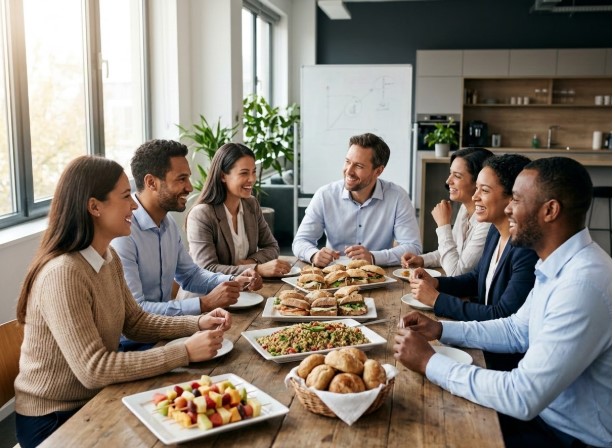
A good meal can change the rhythm of a workday. Conversations slow down, people leave their desks, and the usual stream of notifications temporarily loses its grip. Even a short shared lunch can create space for people who spend most of the day working through screens, messages, documents, and deadlines to speak with one another in a more natural setting.
Food has a practical role in working life because eating already occupies time in every schedule. A business can leave that time to chance, with employees eating alone at their desks or rushing out between meetings, or it can create an occasion that gives people a reason to pause together. The difference can be surprisingly meaningful. Shared meals can encourage informal learning as conversations tend to move beyond the immediate task.
Shared Food Creates Opportunities for Informal Learning
Some of the most useful knowledge inside a business sits with people who have learned through repetition. A customer service representative may know how to identify a frustrated caller before the conversation escalates, and an operations employee may recognize a problem in a process long before it appears in a report.
That knowledge can be difficult to transfer through formal training alone. After all, it is often based on small observations and accumulated experience. Shared meals create opportunities for those details to surface because people tend to compare experiences when conversation is relaxed.
A lunch can also bring together employees who rarely have a reason to speak. Departments often develop their own language, priorities, and daily concerns. A meal can place different perspectives around the same table.
The conversation does not need to become a workshop. A simple question about how another department handles a problem can open the door to useful information. One answer can lead to another. A process that seemed obvious from one side of the business can look very different from another.
That kind of exchange can support better cooperation because people begin to understand the conditions under which their colleagues work. The benefit can be especially noticeable for new employees. A formal onboarding session may explain reporting structures and procedures, while a shared meal can introduce the people behind those functions.
Meals can also create opportunities for mentoring without requiring a formal mentoring program. An experienced employee may share an approach that took years to develop, while a newer colleague can ask practical questions. The conversation can move between work and everyday topics, making professional advice feel more accessible.
Motivating your team is, thus, best done through accessibility. Employees often respond to being given time and attention in ways that cannot be reduced to a perk or a policy. A meal communicates that taking a break and spending time with colleagues should have a legitimate place in the workday.
Good Catering Keeps the Focus on People
Feeding a team does not require an elaborate menu. In many workplaces, the best options are practical foods that travel well, can be served without complicated preparation, and offer enough variety for different preferences.
Rice dishes are particularly useful for group meals because they can support a wide range of flavors and ingredients. A large tray of seasoned rice with grilled chicken, roasted vegetables, herbs, and sauces can feed a group without creating a complicated serving process. Cooking basmati rice requires attention to water, timing, and texture, yet once prepared properly, the grains provide a versatile base for a meal that can be adapted to different tastes.
Basmati rice also works well with foods that can be prepared separately. A team meal might include spiced vegetables, roasted meats, beans, yogurt sauces, and fresh herbs. Employees can combine the ingredients according to preference rather than receiving identical portions. That flexibility can make group catering easier without turning the meal into a complicated production.
Pasta can offer the same practicality. Traditional pasta salad can feel predictable, while upgraded pasta salads can make a simple catering option feel more considered. Roasted vegetables, fresh herbs, olives, grilled chicken, cheese, beans, pesto, or a bright vinaigrette can turn the dish into something substantial enough for lunch.
The key is preparation that allows people to eat comfortably. Foods that can sit briefly without losing their quality are often better suited to workplace meals than dishes that require precise timing. Easy serving also leaves more time for conversation. Drinks, fruit, bread, and a simple dessert can complete the meal without creating unnecessary work.
Stepping Away From the Screen Has Practical Value
A meal away from a desk can create a clear separation between concentrated work and rest, which can help prevent lunch from becoming another period of divided attention.
Eating while answering emails encourages neither focused work nor genuine rest. The employee remains mentally attached to unfinished tasks while also trying to eat. A shared meal changes the physical environment and makes screen checking less natural.
The effect can be particularly useful during periods of intense work. Long stretches of concentrated effort can narrow attention. A short break can create enough distance for a problem to look different when work resumes. A conversation with a colleague can also introduce an idea that would not have emerged while staring at the same document.
Workplace productivity depends on sustained attention, which, in turn, requires periods in which it can recover. A meal provides a practical structure for that pause.
The social side matters as well. People who rarely speak outside formal meetings may discover common interests or shared experiences. Colleagues may develop enough familiarity to ask for help more comfortably later.
Team-building can sound forced when it is packaged as an activity with a predetermined lesson. A meal offers a simpler alternative: people can spend time together without being asked to perform a team-building exercise.
Food Supports a Better Working Rhythm
A workplace meal can create a pause in a demanding day, open a conversation between colleagues who rarely interact, and give practical knowledge a chance to move from one person to another.
The strongest benefits often come from the ordinary nature of the experience: nobody needs to deliver a speech, after all. A meal can simply provide time for people to share space and conversation.
That time can support motivation because employees are given a reason to step away from their screens and reconnect with the people around them. It can support learning because useful experiences surface naturally during conversation.
Thus, feeding a team deserves more thought than choosing the cheapest convenient option. A well-planned meal can improve the rhythm of a workday while creating opportunities for relationships and knowledge to develop. Admittedly, good food doesn’t solve every workplace problem, but it can create the conditions for better conversations, stronger connections, and a more sustainable way of working.