

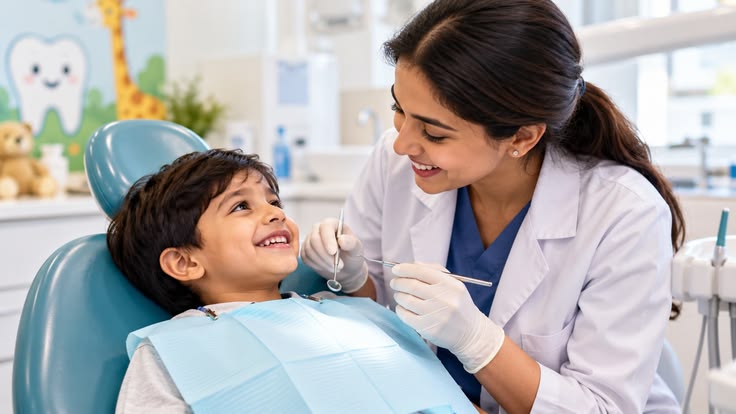
Children’s teeth develop in stages. Baby teeth start coming in, stay in place for several years, and eventually fall out as adult teeth grow. Most parents know how this works, but it can be harder to tell whether their child’s teeth are coming in at the right time. If a tooth appears earlier or later than expected, it’s not always clear whether that’s normal or something a dentist should check.
This guide explains when baby teeth and adult teeth are expected to come in, from your child’s first tooth to their full set of adult teeth.
When Baby Teeth Come Through
Most babies get their first tooth at around six months, although it’s normal for teeth to start coming in anywhere between four and twelve months. The two lower front teeth usually appear first, followed by the upper front teeth.
The rest of the baby teeth come in gradually over the next couple of years. By age three, most children have all 20 baby teeth.
Every child develops at their own pace, so a tooth coming in a few months earlier or later than expected isn’t necessarily a reason to worry.
What is worth paying attention to:
A baby tooth that has not appeared by 18 months. This does not necessarily indicate a problem, but a dentist can check whether the teeth are developing under the gum.
Teeth coming through in an unusual order. Minor variations are common, but significant departures from the expected pattern can sometimes point to developmental issues worth monitoring.
Looking After Baby Teeth (and Why They Matter More Than People Think)
There is a common assumption that baby teeth do not need much attention because they fall out anyway. This is one of those things that sounds logical but misses something important.
Baby teeth hold space for the adult teeth developing underneath them. When a baby tooth is lost early to decay or extraction, the surrounding teeth can shift into the gap, which affects where the adult tooth comes through. Crowding and alignment problems later on can sometimes trace back to a baby tooth that was lost before its time.
Baby teeth also affect how a child eats, speaks, and develops confidence around smiling. Decay in baby teeth can cause pain and infection, and treating a toddler for dental pain is harder on everyone than preventing it.
Practical care from the start:
Begin brushing as soon as the first tooth appears, using a soft infant toothbrush and a smear of fluoride toothpaste
Supervise brushing until around age seven or eight; children under this age do not have the coordination to brush thoroughly on their own
Limit sugary drinks between meals, including fruit juice and flavoured milk
Book a first dental visit by the child’s first birthday, or within six months of the first tooth appearing
When Baby Teeth Start Falling Out
Baby teeth begin to loosen and fall out around age six, starting with the lower central incisors (the same ones that came through first). The process continues until roughly age twelve, when the last baby molars are replaced.
| Age range | What to expect |
| 6 to 7 | Lower and upper central incisors fall out |
| 7 to 8 | Lateral incisors (next to the front teeth) |
| 9 to 11 | First molars and canines |
| 10 to 12 | Second molars (the last baby teeth) |
These ranges are approximate. Some children lose their first tooth at five, others not until seven. Both are within the normal window.
A few things that are worth checking with a dentist:
A baby tooth that is still firmly in place well past the expected age, with no sign of loosening
An adult tooth coming through behind or beside a baby tooth that has not fallen out (sometimes called “shark teeth”)
A baby tooth that falls out very early, before age four or five, without an obvious reason like an injury
Adult Teeth and What to Watch For
The adult teeth come through in stages alongside the baby teeth falling out. The first adult molars arrive around age six, behind the baby molars rather than replacing them, so they can be easy to miss. These are permanent teeth and worth protecting from the start.
By age thirteen, most children have 28 adult teeth. The four wisdom teeth, if they develop, tend to appear between ages seventeen and twenty-five.
During the mixed-dentition phase (roughly ages six to twelve, when both baby and adult teeth are present), a child’s mouth can look crowded or uneven. This is normal. The jaw is still growing, and spacing tends to improve as it does. A dentist can tell the difference between temporary crowding that will resolve on its own and early signs of alignment issues that may benefit from intervention.
At Auburn Smiles, the team sees children through each of these stages and can advise on whether what a parent is noticing is within the expected range. The practice has dentists who speak English, Arabic, Farsi, and Dari, which makes the conversation easier for families across Western Sydney’s multicultural communities.
When to See a Dentist Between Routine Visits
Routine check-ups every six to twelve months are the foundation. But there are a few situations that warrant a visit in between:
A chipped or knocked-out tooth from a fall or impact. Time matters here, particularly for adult teeth. If an adult tooth is knocked out completely, keep it moist (in milk or saliva) and see a dentist within 30 minutes if possible.
Persistent pain that does not ease with paracetamol. This can indicate an abscess or deep decay.
Swelling in the gum or face around a tooth.
A child complaining of sensitivity to hot or cold that lasts more than a few seconds after the food or drink is gone.
For any of these, a same-day or next-day appointment is better than waiting for the next scheduled check-up.
Frequently Asked Questions
At what age should a child first see a dentist?
The Australian Dental Association recommends a first visit by the child’s first birthday or within six months of the first tooth coming through. This is a short, low-pressure appointment that gets the child used to the dental environment.
Are dental X-rays safe for children?
Yes. Modern dental X-rays use very low doses of radiation, and the diagnostic value of catching problems early outweighs the minimal exposure. A dentist will only take X-rays when there is a clinical reason to do so.
What if my child is afraid of the dentist?
This is common, and most family-focused practices are experienced at working with anxious children. Letting the child sit in the chair and meet the dentist without any treatment on the first visit can help. Talking about the appointment in neutral terms beforehand (avoiding phrases like “it will not hurt,” which can introduce the idea of pain) also makes a difference.
Do children need to floss?
Once any two teeth are touching each other, flossing between those teeth helps prevent decay in spots a toothbrush cannot reach. For young children, a parent will need to do this for them.
Children’s dental development follows a broad pattern, but every child moves through it at their own pace. Knowing what to expect at each stage makes it easier to tell the difference between normal variation and something that needs attention. A dentist who sees your child regularly has the full picture and can flag anything early, which is the whole point of keeping those check-ups consistent.