

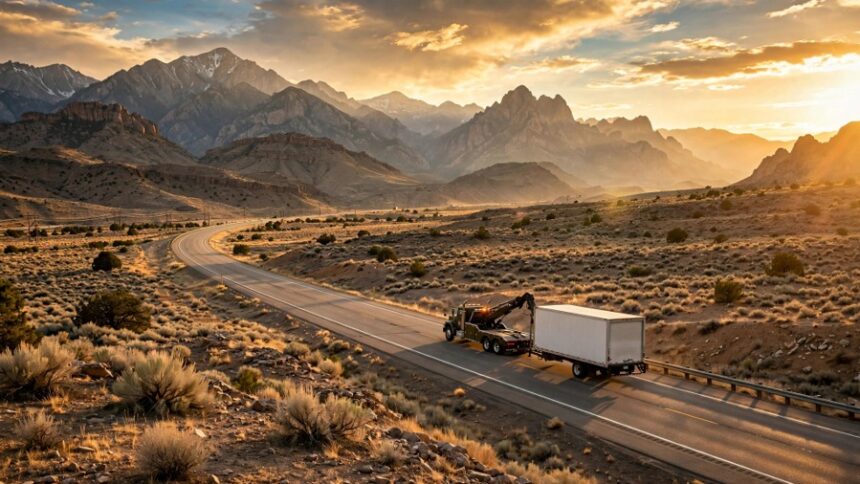
I-15 heavy duty towing in northern Utah means getting a crew with wreckers, winch trucks and recovery gear to a stalled or crashed rig around Brigham City, Honeyville and Tremonton, where truck traffic, farm vehicles and strong winds all share the road. That’s the quick answer. The bigger picture includes the roads that branch off I-15. I-84 heads northwest across empty ranch country toward Idaho, US-89 and US-91 run past Willard Bay and up toward Cache Valley, and I-80 carries freight through Evanston across southwest Wyoming. Bozz Towing & Diesel Roadside covers all five from yards in Corinne, Utah, and Evanston, Wyoming. You’ll see where each road tends to break trucks and what makes the remote stretches risky. You’ll also get a few details that help a crew find you faster, plus the gaps where another company might be the smarter call.
I-15 Heavy Duty Towing Through Box Elder County
The company’s I-15 coverage focuses on the busy stretch from Brigham City up through Honeyville to Tremonton and Garland, close to the Corinne yard.
Brigham City’s Busy Interchanges
Exit 362, where US-91 and US-89 meet I-15, is the big one. It has a full truck stop, heavy congestion at commuter times, and plenty of trucks merging with local traffic. Loaded trucks coming down into the interchange also wear their brakes hard. A short hop north, Exit 363 at Forest Street brings quick merges and lots of local cars on the ramps. Exit 365 at SR-13 is the Corinne access, where industrial and farm vehicles mix with freight and road debris causes tire failures. Personally, I think this cluster of exits is where a nearby yard pays off most, since a stalled rig here blocks traffic for both commuters and long-haul drivers.
Honeyville to Tremonton, Where Wind Takes Over
North of Brigham City, the land opens up. Around Exit 372 at Honeyville, high winds push on trailers, trucks slow down on the grades while cars keep their speed, and shoulders are tight. Exit 376 at Tremonton has a busy travel stop, and trucks sometimes arrive with overheated brakes as they pull into the service area. Near Garland at Exit 381, farm equipment shares the road, ramps are slow, and the pavement at the shoulder can be uneven. That last detail matters, because a heavy truck stopping on a rough shoulder can sink or tilt, which makes the hookup harder.
I-84 Runs Long, Lonely and Light on Fuel
Once I-84 splits from I-15 near Tremonton and heads northwest toward Snowville, it becomes one of the most remote interstates in the region. The company lists exits from Tremonton out past Howell, Valley, Blue Creek and Snowville, and the notes read like a warning. Some ranch exits have no services at all. The Valley exit sits roughly 30 miles from fuel in either direction. Wind gusts sweep across the open valleys near Blue Creek, and wildlife crosses at dawn and dusk. Near Howell, the area around the Golden Spike, farm trucks enter and exit and industrial vehicles drop debris. So I-84 heavy duty towing often involves a long drive to reach you and a long tow back out. Here’s a hands-on tip for this stretch: top off your fuel in Tremonton before heading west, because running dry between those ranch exits turns a simple fuel delivery into a long wait.
Wyoming I-80 Punishes Empty Trailers
On the Wyoming side, the Evanston yard covers I-80 from town east toward Fort Bridger, Mountain View, Granger and the Rock Springs approach. Near Evanston, trucks crowd the main access ramps around the truck stops, and winter ice builds on the ramps. Just beyond town, crosswinds, drifting snow and trailer sway become the main threats. The industrial and energy corridor around Church Buttes brings debris and blowouts, and the miles between exits stretch long. Fort Bridger sees harsh winter weather and summer overheating on the grades. Near Mountain View, the company describes a strong wind corridor where trucks strain on the climbs and brakes fade on the descents. Granger offers little more than a rest area. All of that makes I-80 heavy towing a mix of winter recoveries, wind-related rollovers and long-distance tows. In my view, empty trailers face the biggest risk on this road, because they catch the wind and tip much more easily than loaded ones.
US-89 Hugs the Bay and Climbs Toward the Mountains
US-89 starts at the busy Brigham City junction, then runs south through Perry and Willard toward Ogden. In Perry, traffic signals, pedestrians and stop-and-go flow wear down brakes on heavy loads. Along Willard Bay, strong crosswinds come off the open water, the shoulders are narrow and wildlife crosses the road. Closer to Ogden, traffic gets denser and trucks run hotter in slow traffic. Heading north, the route climbs toward Cache Valley, with grades that heat brakes on the way down and ice risk in winter. If you’re searching for a US-89 tow truck near me, odds are you’re stuck on a stretch with little room to pull over and wind pushing on your vehicle. Light-duty flatbeds handle the cars and pickups, while the heavy wreckers and winch trucks take care of anything bigger.
US-91 Mixes Farm Traffic With Freight
US-91 shares the Brigham City junction with US-89, then follows its own path through the Corinne access road, Perry and Willard toward the North Ogden area. Near Corinne, farm equipment, road debris and tight turning space make heavy moves tricky. Perry brings signals, pedestrian crossings and brakes that overheat in town traffic. Around Willard, crosswinds, wildlife and narrow shoulders limit where a truck can safely stop. When you need a US-91 heavy wrecker near me, the Corinne yard’s location helps a lot, since this corridor runs right past its doorstep. The heavy fleet’s 50-ton winch trucks and rotator crane give the crew options when a rig slides off a soft shoulder into a field, which happens more than you’d think in farm country.
Read the Road Before You Call
The more you tell dispatch, the faster the right truck shows up. Start with your highway, direction and nearest exit or mile marker. On I-84 and the open stretches of I-80, a GPS pin from your phone is often more useful than a guess, since landmarks are few. Next, describe your truck, trailer and load, and say whether the trailer is empty, because that affects how the crew handles wind on scene. Mention what the truck is doing, such as an air leak, a coolant problem, a dead battery or a warning light. Bozz’s road service can often fix those issues on the spot, and if it can’t, the job turns into a tow or recovery without another phone call. And if you’re blocking a lane, someone’s hurt or there’s a fire, call 911 first.
Gaps This Crew Can’t Close
Real talk, there are limits. The company’s highway list for I-15 centers on the Brigham City to Tremonton stretch, so if you break down farther south in the Ogden or Davis County area, ask about timing when you call. The far western end of I-84 near Snowville is remote enough that any company will need a long drive to reach you. On I-80, the Rock Springs and Green River end sits at the edge of Bozz’s range, so a crew based there may arrive sooner. The website doesn’t post prices either, since heavy jobs depend on distance, weight and recovery work, so get an estimate up front. And keep in mind that the main line is (435) 767-7991, while the Evanston page lists (435) 465-6879 for Wyoming calls.
Know Your Mile Marker, Know Your Crew
Northern Utah and southwest Wyoming hit heavy trucks with wind, ice, long grades and very long gaps between services. I-15 brings busy interchanges and gusty open stretches. I-84 means remote ranch country with little fuel. I-80 punishes empty trailers in the wind. US-89 and US-91 mix narrow shoulders, farm traffic and crosswinds off Willard Bay. Plan your fuel, watch the weather, and when trouble hits, give your exit, mile marker or GPS pin plus what the truck is doing. Then let a crew with roadside repair, heavy towing and recovery handle the rest. Save (435) 767-7991 before your next run.
Frequently Asked Questions
What should I do if I run out of fuel on a remote interstate?
Pull fully off the road, turn on your hazards and call for fuel delivery with your exact mile marker or GPS pin. On remote stretches, it can take longer for help to arrive, so stay with your vehicle if it’s safe.
Why are crosswinds dangerous for semi trucks?
Strong side winds push on the large flat sides of a trailer, which can cause sway, jackknifing or rollovers. Empty and lightly loaded trailers face the highest risk.
How do tow companies recover a semi from a soft shoulder?
Crews use winch trucks and rigging to pull the rig back onto firm ground slowly and evenly. In tougher cases, a rotator or crane may lift part of the truck or trailer.
Can brakes overheat on a highway exit ramp?
Yes, heavy loads and long downhill approaches build heat in the brakes, especially near busy interchanges. Overheated brakes can fade, so drivers should slow down early and use lower gears.
Do heavy towing companies cover both Utah and Wyoming?
Some do, and Bozz Towing runs yards in Corinne, Utah, and Evanston, Wyoming. That lets it cover I-15, I-84, US-89, US-91 and I-80 across both states.