

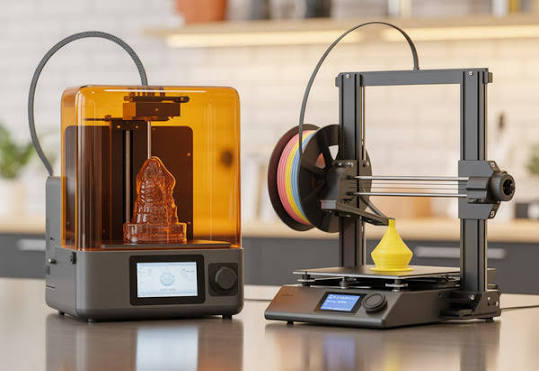
Most people shopping for their first 3D printer start by comparing machines, when the more useful starting question is what material they actually need to print in. Filament and resin are not simply two flavours of the same technology. They produce different results, suit different projects, and come with entirely different running costs, so getting this decision right first saves a lot of buyer’s remorse later.
How Filament Printing Actually Works
Fused deposition modelling machines melt a spool of 3D printer filament and extrude it layer by layer through a heated nozzle. PLA is the easiest material to start with since it prints at lower temperatures and barely warps. PETG and ABS step up in strength and heat resistance but demand more from the printer, often needing an enclosure and a heated bed to print reliably.
Filament printing is forgiving, relatively clean, and cheap to run. A functional bracket, a phone stand, or a replacement part for a broken appliance are all classic filament jobs. What it is not particularly good at is fine surface detail, since visible layer lines are unavoidable at typical print settings.
How Resin Printing Closes That Gap
A resin 3D printer works completely differently. Instead of melting plastic, it uses a light source underneath a vat of liquid photopolymer resin, curing it layer by layer to build the part upside down off the build plate. The result is a smoothness and level of fine detail that filament printing simply cannot match at a comparable price point.
The trade-off is mess and cost. Resin needs to be handled with gloves, cured parts require an isopropyl alcohol wash and a post-cure step under UV light, and uncured resin is more of a disposal consideration than empty filament spools ever are. It is also the pricier option per print when you factor in resin cost, alcohol, and consumables like the vat film.
Matching the Material to the Project, Not the Other Way Around
A rough rule that holds up well in practice: if the part needs to survive load-bearing use, get handled roughly, or be printed in a hurry, filament is the right call. If the part needs fine detail, a smooth surface finish, or precise dimensional accuracy on a small scale, resin wins comfortably. Miniatures, jewellery masters, dental models, and small mechanical prototypes with tight tolerances all fall firmly into resin territory.
Where Elegoo Fits Into the Resin Conversation
For buyers leaning toward resin, Elegoo 3D printers have built a strong reputation for reliable performance without pushing prices into premium territory. The lineup covers everything from compact entry-level machines suitable for a first resin printer to larger-volume units aimed at users producing multiple parts per print run, which makes it a sensible brand to shortlist regardless of budget.
Can You Eventually Own Both?
Plenty of serious hobbyists and small workshops end up running one filament printer and one resin printer side by side, using each for what it does best rather than forcing one machine to cover every job. That is not an unreasonable long-term plan, but for a first purchase, it is far better to be honest about what you will actually print in the next six months rather than buying for a hypothetical future project.
Choosing between filament and resin is not really a question of which technology is superior. It is a question of matching the tool to the job in front of you, and that single decision will do more for your print quality than any amount of tinkering with settings afterward.