

Some images seem to arrive in our minds fully formed. A soup can, a movie star’s face, a Coca-Cola bottle, a gleaming dollar sign. We recognize them almost instantly, before we have time to consider why they feel so familiar.
Andy Warhol understood that kind of visual magic. He took images already woven into American life and gave them a new stage, surrounding them with vivid color, bold composition, and the unmistakable pulse of Pop Art.
Campbell’s Soup, Marilyn Monroe, Elvis Presley, Jackie Kennedy, flowers, and symbols of wealth all became part of his remarkable visual vocabulary.
That enduring fascination lives on in Andy Warhol prints, where signed editions, screenprints, celebrity portraits, commercial imagery, flowers, dollar signs, and other iconic subjects invite viewers to look twice.
The image may be familiar, but under Warhol’s eye, familiarity becomes something richer: a reason to pause, remember, and see it differently.
1. Warhol Knew the Power of a Familiar Image
Andy Warhol had an extraordinary instinct for images that already occupied a place in the public imagination.
He found them in magazine photographs, supermarket packaging, advertising, celebrity portraits, newspapers, and the symbols of American life. Then he gave those images his own visual treatment, turning the familiar into something instantly recognizable as Warhol.
That instinct runs through his prints. The subject may already be known, yet Warhol’s choice of color, scale, repetition, and composition gives it an entirely different presence.
2. Warhol Turned Celebrity Into Art
Few artists understood celebrity quite like Warhol.
Marilyn Monroe, Elvis Presley, Jackie Kennedy, and other famous figures became some of his most recognizable subjects. Their faces already carried glamour, fame, beauty, tragedy, and cultural memory, giving Warhol a rich visual foundation to reinterpret.
His portraits often began with a photographic source, which he transformed through screenprinting and vivid color. Marilyn could appear in radiant pinks and yellows, while another version might feel cooler, darker, or more dramatic.
The face remains unmistakable. The atmosphere changes.
3. Color Became Part of Warhol’s Signature
Color is one of the first things people notice in a Warhol print.
He used unexpected combinations with confidence, surrounding familiar faces and objects with saturated pinks, oranges, blues, yellows, and greens. The result could feel glamorous, playful, theatrical, or almost dreamlike.
For Warhol, color was more than decoration. It could completely alter an image’s character while preserving the recognition that made the subject so powerful.
This is particularly striking across his portraits. The same celebrity can appear transformed simply through a different palette, giving each work its own visual personality.
4. Campbell’s Soup Became Pure Warhol
Campbell’s Soup may be one of the clearest examples of Warhol’s ability to find beauty in an image that was already everywhere.
The familiar red-and-white label became one of his defining motifs. In his 1962 Campbell’s Soup Cans, Warhol presented 32 canvases representing different soup varieties, turning supermarket packaging into a bold artistic statement.
Later, the subject appeared again in screenprints and other works.
Warhol’s fascination with the can went beyond the object itself. Its typography, colors, repetition, and unmistakable branding gave him an image he could recognize at a glance and endlessly reinterpret.
It became one of those rare subjects that people could identify from across a room and still enjoy examining up close.
5. Screenprinting Gave Warhol Room to Experiment
Warhol’s embrace of screenprinting was central to his work’s look.
The process allowed him to work from photographic imagery while producing multiple impressions and experimenting with different colors and arrangements. It also introduced subtle variations in ink, registration, and surface that could give individual prints their own character.
That balance between repetition and variation became particularly important throughout his career.
A Warhol print can therefore be appreciated on several levels. There is the instantly recognizable subject, the bold graphic composition, and the physical presence created by the printing process itself.
For collectors, those details can make looking at an individual print a much richer experience.
6. Warhol Found Beauty in Unexpected Places
Warhol’s subjects extended far beyond celebrities and Campbell’s Soup.
Flowers, dollar signs, Coca-Cola imagery, advertisements, newspaper photographs, and other recurring motifs reveal the breadth of his visual curiosity. He could move from a glamorous portrait to a simple graphic symbol while maintaining a distinctive artistic language.
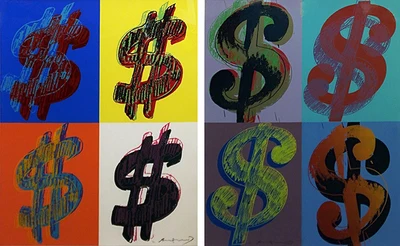
His dollar sign imagery is especially revealing. A familiar symbol associated with money becomes a striking graphic form, with its curves, lines, and repetition giving it a visual life of its own.
Flowers offered a different kind of beauty. Warhol’s characteristic use of color and repetition turned their organic forms into vibrant compositions.
Across these subjects, the artist’s signature remained recognizable.
7. Looking Again Reveals More Warhol
The first glance at a Warhol print is often immediate. The colors strike first, followed by recognition of the subject.
Then the details begin to emerge.
A collector might notice the relationship between image and color, the scale of the composition, the qualities of the screenprint, or the way Warhol altered a familiar photograph.
Edition information, signature, provenance, condition, and the work’s relationship to a larger series can add another layer to the experience.
That is part of the pleasure of Warhol’s work. His imagery can announce itself instantly while still rewarding a slower look.
Warhol knew how to make an image unforgettable. He also knew how to make familiarity feel fresh again, giving faces, products, symbols, and flowers a new life through color, printmaking, and his unmistakable artistic vision.
That may be the enduring magic of an Andy Warhol print: you recognize it immediately, then find yourself looking a little longer.