
Quitting alcohol after heavy, prolonged drinking sounds straightforward on the surface. Stop drinking, feel better, move on. The reality is considerably more complicated, and for some people, genuinely dangerous. Alcohol withdrawal is one of the few substance withdrawal syndromes that can become life-threatening without proper medical supervision. Understanding what the body goes through, why it happens, and what options exist for managing it safely can make a real difference for anyone considering stopping or helping someone who is.
This article walks through the biology behind alcohol withdrawal, the stages and timeline a person typically experiences, the warning signs that demand immediate medical attention, and what medically supervised detox actually looks like in practice.
Why Alcohol Withdrawal Happens at All
To understand withdrawal, it helps to understand what chronic heavy drinking does to the brain. Alcohol is a central nervous system depressant. It works primarily by enhancing the activity of gamma-aminobutyric acid, or GABA, the brain’s main inhibitory neurotransmitter, while simultaneously suppressing glutamate, the main excitatory neurotransmitter. The net effect is sedation, reduced anxiety, and slowed neural activity.
When someone drinks heavily day after day, the brain tries to compensate. It downregulates GABA receptors, making the inhibitory system less sensitive, and upregulates glutamate receptors, making the excitatory system more active. This is tolerance. The brain has essentially recalibrated itself to function in the presence of alcohol.
Remove the alcohol suddenly, and the brain is left in a hyperexcited state. GABA activity is suppressed, glutamate activity is amplified, and the nervous system fires with far more intensity than it should. That neurological storm is alcohol withdrawal. The severity depends largely on how long someone has been drinking heavily, how much they consumed, and whether they have withdrawn before.
The Timeline: What Happens and When
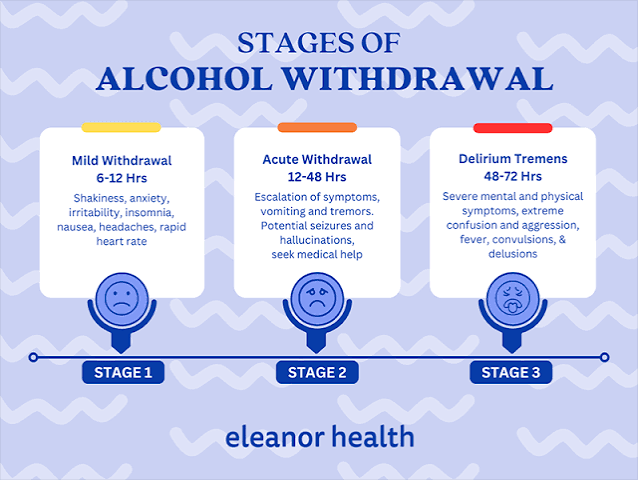
Alcohol withdrawal does not follow the same schedule for every person, but there is a general progression that clinicians use to anticipate and monitor symptoms. The timeline below represents common patterns, though individual variation is significant.
| Time After Last Drink | Common Symptoms | Risk Level |
| 6 to 12 hours | Anxiety, tremors, sweating, nausea, headache, insomnia | Mild to moderate |
| 12 to 24 hours | Increased tremors, elevated heart rate and blood pressure, irritability, hypersensitivity to light and sound | Moderate |
| 24 to 48 hours | Risk of seizures peaks; hallucinations (auditory, visual, or tactile) may occur | High |
| 48 to 72 hours | Delirium tremens (DTs) may develop; severe confusion, fever, autonomic instability | Potentially life-threatening |
| 72 hours and beyond | Gradual resolution in uncomplicated cases; prolonged symptoms possible in severe cases | Decreasing with treatment |
It is worth emphasizing that most people who go through alcohol withdrawal experience only mild to moderate symptoms. However, the subset who develop severe complications, particularly delirium tremens, face real medical emergencies. According to research published in the journal Alcohol and Alcoholism, delirium tremens carries a mortality rate of up to 37 percent when untreated, dropping to approximately 5 percent or lower with proper medical care.
Recognizing the Danger Signs
Knowing which symptoms signal a medical emergency is critical, both for the person withdrawing and for anyone around them. Some warning signs are easy to dismiss as ordinary discomfort, but certain combinations should prompt immediate action.
- Seizures: These can occur with little warning and carry serious risks of injury, aspiration, and prolonged neurological effects.
- High fever combined with confusion: This combination often signals delirium tremens, which requires hospitalization.
- Severe disorientation or hallucinations: Hallucinations in alcohol withdrawal are not always a sign of DTs on their own, but when paired with agitation and autonomic instability, the picture is serious.
- Rapid heart rate above 100 beats per minute at rest: Persistent tachycardia combined with other symptoms suggests the nervous system is under significant stress.
- Extreme sweating and uncontrollable shaking: These autonomic signs, especially when severe, indicate the body is struggling to regulate itself.
- Unresponsiveness or loss of consciousness: An immediate 911 situation without exception.
A useful clinical tool used by healthcare providers is the Clinical Institute Withdrawal Assessment for Alcohol, revised version, commonly called the CIWA-Ar. It scores ten symptom categories to determine withdrawal severity and guide treatment decisions. Scores above 15 generally indicate a need for pharmacological intervention and close monitoring.
Medical Detox: What It Actually Involves
Medical detox is not simply a place to “dry out.” It is a structured clinical process aimed at keeping the nervous system stable while the body clears alcohol and begins to readjust. The gold standard pharmacological treatment for alcohol withdrawal is benzodiazepines, which act on the same GABA receptors that alcohol affects, essentially providing a controlled, tapering substitute that prevents the nervous system from reaching dangerous levels of hyperexcitability.
Diazepam and lorazepam are among the most commonly used agents. Dosing is typically symptom-triggered, meaning clinicians reassess frequently using structured tools like the CIWA-Ar and adjust medications accordingly. This prevents both under-treatment, which leaves the patient at risk, and over-sedation.
Beyond medications, medical detox involves monitoring vital signs, checking electrolytes, administering thiamine (vitamin B1) to prevent Wernicke’s encephalopathy, a serious neurological condition linked to nutritional deficiencies common in heavy drinkers, and providing hydration support. The physical care is thorough precisely because the body is dealing with multiple stressors simultaneously.
Facilities that offer this level of care vary widely. Some are hospital-based, others are residential programs with on-site medical staff. For those looking into options in California’s Central Valley, https://visaliarecoverycenter.com/ is one resource that provides information on medically supported programs in the Visalia area, which can be a useful starting point for understanding what local care looks like.
The Role of Kindling in Repeated Withdrawal
One phenomenon that does not get enough attention in public discussions of alcohol withdrawal is kindling. The term refers to the way repeated cycles of heavy drinking followed by withdrawal can progressively worsen the severity of withdrawal over time.
Each withdrawal episode sensitizes the nervous system. The neural pathways involved in the hyperexcitable withdrawal response become easier to activate. Clinically, this means someone who experienced only mild anxiety and tremors during an early withdrawal might face seizures or hallucinations during a later episode, even if their drinking patterns were similar. A 2021 review in the journal Alcohol Research noted that prior withdrawal episodes are among the strongest predictors of severe withdrawal complications.
This has a practical implication. People who have gone through withdrawal multiple times should not assume that because they managed it once at home, they can do so again safely. The risk profile genuinely changes.
What Comes After Detox
Detox addresses the acute physical crisis. It does not address the reasons someone developed alcohol dependence in the first place, the psychological patterns that sustain heavy drinking, or the social and environmental factors that may make sobriety difficult to maintain. This is why treatment specialists consistently frame detox as a beginning, not an end.
Post-detox care typically involves one or more of the following levels of support, depending on the individual’s situation.
- Residential treatment: Living at a facility while receiving intensive therapy, medical oversight, and peer support. Usually 30 to 90 days.
- Partial hospitalization programs (PHP): Structured daily programming, typically five to six hours per day, while living at home or in sober housing.
- Intensive outpatient programs (IOP): Several hours of therapy per week, allowing for work or family responsibilities.
- Standard outpatient: Weekly individual or group therapy sessions, appropriate for lower-risk situations or as a step-down from higher levels of care.
- Medication-assisted treatment (MAT): FDA-approved medications such as naltrexone, acamprosate, or disulfiram can significantly reduce cravings and relapse risk when combined with behavioral support.
- Peer support and mutual aid: Programs like Alcoholics Anonymous, SMART Recovery, and similar groups provide ongoing community connection, which research consistently associates with better long-term outcomes.
The National Institute on Alcohol Abuse and Alcoholism reports that roughly one-third of people who address alcohol problems have no further symptoms one year later. Recovery is not a rare outcome. It is a common one, particularly when people receive structured support rather than attempting to manage alone.
A Few Practical Takeaways
Alcohol withdrawal is a serious medical condition that sits on a spectrum from uncomfortable to life-threatening. The decision to stop drinking after heavy, prolonged use is a genuinely important one, and the body’s response to that decision deserves the same level of care as any other significant medical event. Understanding the timeline, recognizing danger signs, and knowing that effective medical support exists can help people approach that process with more clarity and less fear. Anyone concerned about their own situation or that of someone they care about should speak with a healthcare provider before attempting to stop on their own.